 Back
BackAccessibility in the Age of AI: Designing Inclusive Intelligent Experiences
#Accessibility #DigitalAccessibility #InclusiveDesign #CustomerExperience #DigitalTransformation #EnterpriseAI #TECHVED #TECHVEDConsulting #ExperienceEngineering

Jay Anthony
28 July 2026 | 8 min read
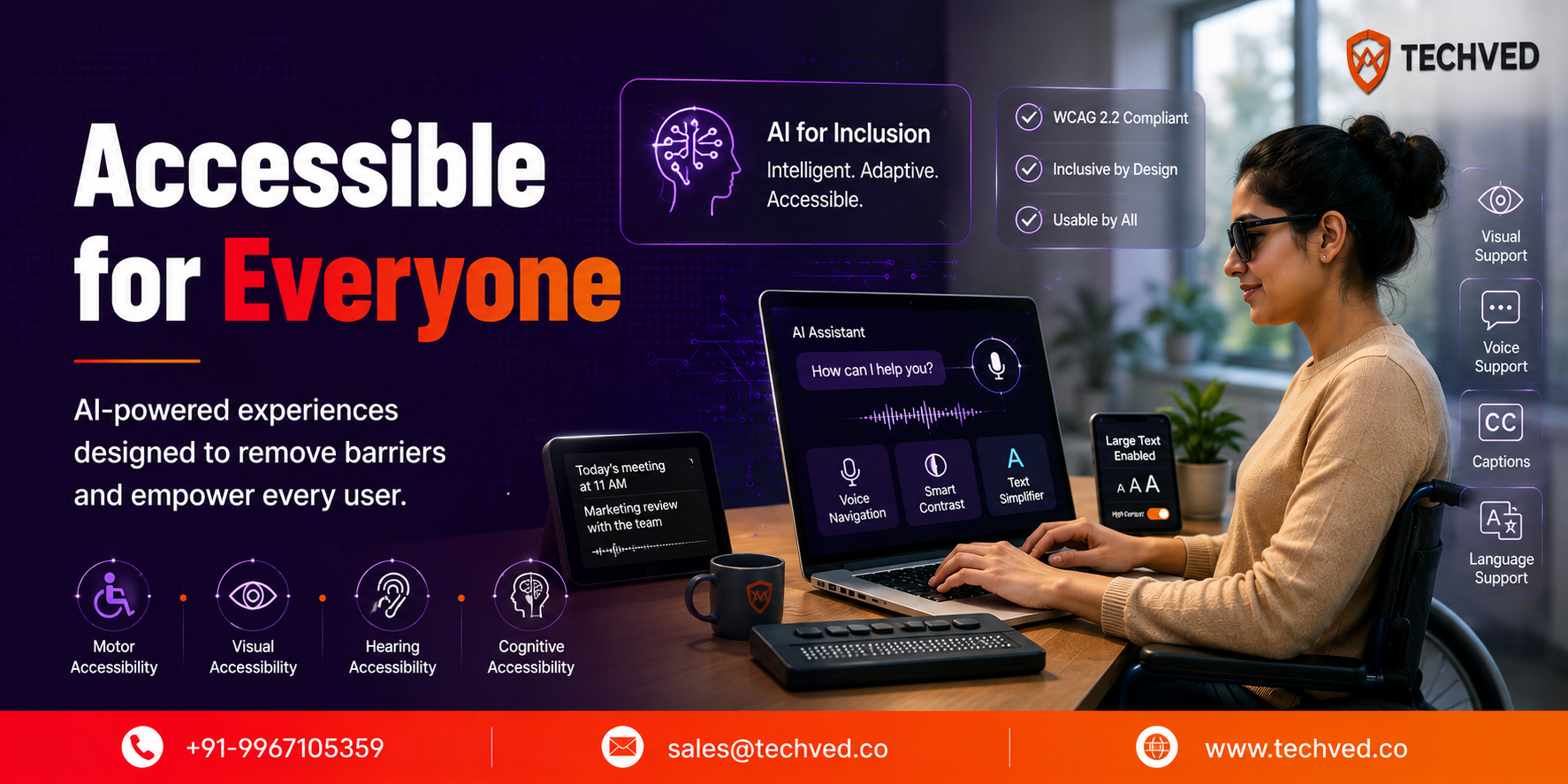
Accessibility in the Age of AI: Designing Inclusive Intelligent Experiences
Artificial Intelligence (AI) is reshaping how people interact with digital products. From conversational assistants and voice interfaces to personalised recommendations and intelligent automation, AI has become an integral part of modern digital experiences. While these advancements are transforming convenience and efficiency, they also present a critical challenge—ensuring that innovation remains inclusive.
Accessibility is no longer just about meeting compliance requirements. In the age of AI, it is about designing intelligent experiences that empower every user, regardless of their abilities, age or circumstances. Organisations that prioritise accessibility from the outset not only create better user experiences but also build trust, improve customer engagement and reach a wider audience.
Why Accessibility Matters More Than Ever
Over one billion people worldwide live with some form of disability, making accessibility an essential aspect of digital product design. Beyond permanent disabilities, many users also experience temporary or situational limitations, such as navigating a mobile device with one hand, using a screen in bright sunlight or interacting in noisy environments.
As AI becomes deeply embedded in digital ecosystems, businesses must ensure that intelligent systems remain usable and accessible for everyone. An AI-powered experience that excludes even a small group of users risks reducing adoption, increasing customer frustration and damaging brand perception.
The Intersection of AI and Accessibility
AI has the potential to remove many of the barriers that have traditionally limited digital accessibility. Rather than relying solely on static accessibility features, AI enables products to adapt dynamically to individual user needs.
For example, AI can generate real-time captions during video calls, provide speech-to-text and text-to-speech capabilities, simplify complex content, recognise images for visually impaired users and personalise interfaces based on user behaviour. These capabilities help create digital experiences that are more intuitive and inclusive.
However, AI alone does not guarantee accessibility. Intelligent systems must be designed responsibly to avoid introducing new barriers such as biased recommendations, inaccessible interfaces or voice assistants that struggle to understand diverse accents and speech patterns.
Challenges Enterprises Need to Address
As organisations adopt AI across customer-facing platforms, accessibility often becomes an afterthought. This can create significant usability challenges.
Some common issues include:
- AI chat interfaces that are incompatible with screen readers
- Voice assistants that fail to recognise different languages or accents
- Visual AI interfaces with poor colour contrast or unclear navigation
- Automated content that lacks descriptive alternative text
- Personalisation algorithms that overlook accessibility preferences
These gaps not only affect user experience but can also expose organisations to compliance risks and reputational damage.
Designing Inclusive AI Experiences
Creating accessible AI-powered products requires a user-first approach that combines technology, design and continuous testing.
Design for Diverse Users
Accessibility should begin during the discovery and design phases. Understanding the needs of users with different abilities helps teams create experiences that work for everyone rather than retrofitting accessibility later.
Build Human-Centred AI
AI should enhance human capabilities instead of replacing them. Providing multiple interaction methods—such as voice, text and touch—allows users to choose the experience that best suits their needs.
Prioritise Transparency
Users should understand how AI is making decisions, especially in critical applications such as healthcare, banking and insurance. Transparent AI builds trust and allows users to remain in control of their experience.
Test with Real Users
Accessibility cannot be validated through automated testing alone. Engaging users with diverse abilities throughout the design process helps identify usability issues that traditional testing methods often miss.
Business Benefits of Accessible AI
Investing in accessibility is not just a design decision—it is a business strategy.
Accessible AI experiences can help organisations :
- Improve customer satisfaction and loyalty
- Expand their reach to a broader audience
- Reduce support requests through better usability
- Strengthen brand reputation
- Support regulatory compliance
- Drive higher product adoption
Most importantly, accessible experiences benefit every user. Features such as voice search, captions, predictive text and adaptive interfaces were originally developed to improve accessibility but are now widely used by all.
AI-Powered Accessibility in Action
Imagine a banking application designed with AI-powered accessibility at its core.
A visually impaired customer opens the app using a screen reader. The interface automatically adjusts to their preferred accessibility settings. An AI assistant guides them through account information using natural voice interactions, explains financial terms in simple language and securely assists with transactions.
At the same time, another customer with limited mobility completes the same tasks using voice commands instead of touch. A third customer travelling in a noisy environment enables live captions during a video consultation with a financial advisor.
Each user interacts differently, yet all receive an equally seamless and secure experience. This is the true value of combining AI with inclusive design.
The Future of Inclusive Digital Experiences
As AI continues to evolve, accessibility must remain a core design principle rather than an optional enhancement. Future digital experiences will increasingly rely on adaptive interfaces, multimodal interactions and context-aware AI that can anticipate user needs while respecting privacy and user control.
Organisations that embed accessibility into their AI strategy today will be better equipped to create products that are resilient, scalable and inclusive by design.
The future of digital innovation is not defined by how intelligent technology becomes—it is defined by how many people it empowers.
Conclusion
AI is transforming the way businesses design, deliver and optimise digital experiences. However, true innovation is measured not only by technological advancement but also by inclusivity.
By combining human-centred design with responsible AI, organisations can create intelligent experiences that are accessible, trustworthy and valuable for every user. Accessibility is no longer a compliance checklist—it is a catalyst for innovation, customer engagement and long-term business growth.
At TECHVED, we believe the most impactful digital experiences are those designed for everyone. By integrating accessibility into every stage of the design and development process, we help enterprises build AI-powered solutions that are inclusive, future-ready and centred around real user needs.
Most Popular
How AI-Driven Video Content Is Revolutionising Business Communication

Synthetic Media Ethics: Maintaining Authenticity in the Age of Avatars
Why AI Is No Longer Optional for the Insurance Industry in 2026
Green AI for Enterprises: Building Energy-Efficient Intelligence at Scale
From Clicks to Conversations: How Video Messaging Is Replacing Traditional Funnels
Introducing HOLA VDA: The Future of Humanized AI Conversations
Digital Literacy 2.0: Navigating the Shift from Text to Video-First Communication
Written By
Jay Anthony
Marketing Head
He led efforts to develop a fully integrated marketing communications plan and growing team. He is responsible for successful corporate re-brand and update of all branded assets.

Stay up-to-date with
all new market trends and
happenings
 #AIVideoContent #AIInBusiness #BusinessCommunication
How AI-Driven Video Content Is Revolutionising Business Communication
#SyntheticMedia #AIEthics #DigitalHumans #AIAvatars
Synthetic Media Ethics: Maintaining Authenticity in the Age of Avatars
#AgenticAI #InsuranceTech #AITrends2026 #InsuranceInnovation
Why AI Is No Longer Optional for the Insurance Industry in 2026
Ready To Transform?
Automate smarter. Create faster. Grow with AI.